South Korea GPA System — 4.0/4.5 Scale 2026 Guide
How the South Korea academic grading system works in 2026 — 4.0 and 4.5 GPA scales, A+ to F letter grades, US 4.0 GPA conversion, transcript examples, and admissions guidance for SKY, KAIST, and POSTECH applicants.

Korean GPA System Overview
South Korea operates one of Asia's most academically competitive university systems. Most Korean universities use either a 4.0 or 4.5 GPA scale, with leading institutions — Seoul National University (SNU), KAIST, POSTECH, Yonsei, and Korea University — favouring the 4.5 scale where A+ earns 4.5 grade points. International recognition of Korean credentials has grown substantially, with SKY graduates and KAIST/POSTECH alumni routinely admitted to top US, UK, and European graduate programmes.
South Korea GPA Scale & Grade Breakdown
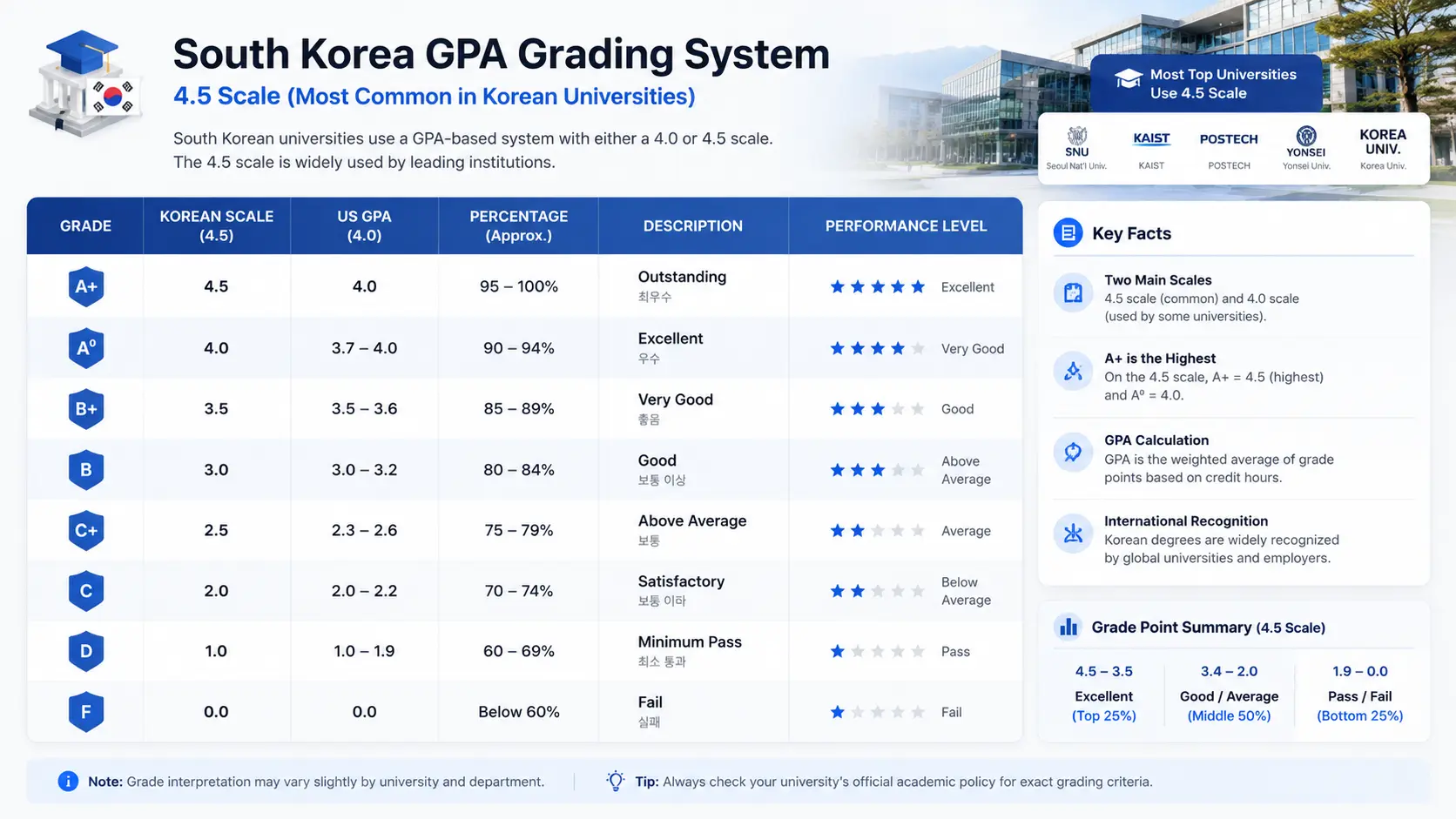
The 4.5 scale (most common at SKY, KAIST, POSTECH): A+ = 4.5, A0 = 4.0, B+ = 3.5, B0 = 3.0, C+ = 2.5, C0 = 2.0, D+ = 1.5, D0 = 1.0, F = 0.0. Some institutions use the 4.3 variant (A+ = 4.3) or the older 4.0 scale.
Korean GPA to US GPA Conversion
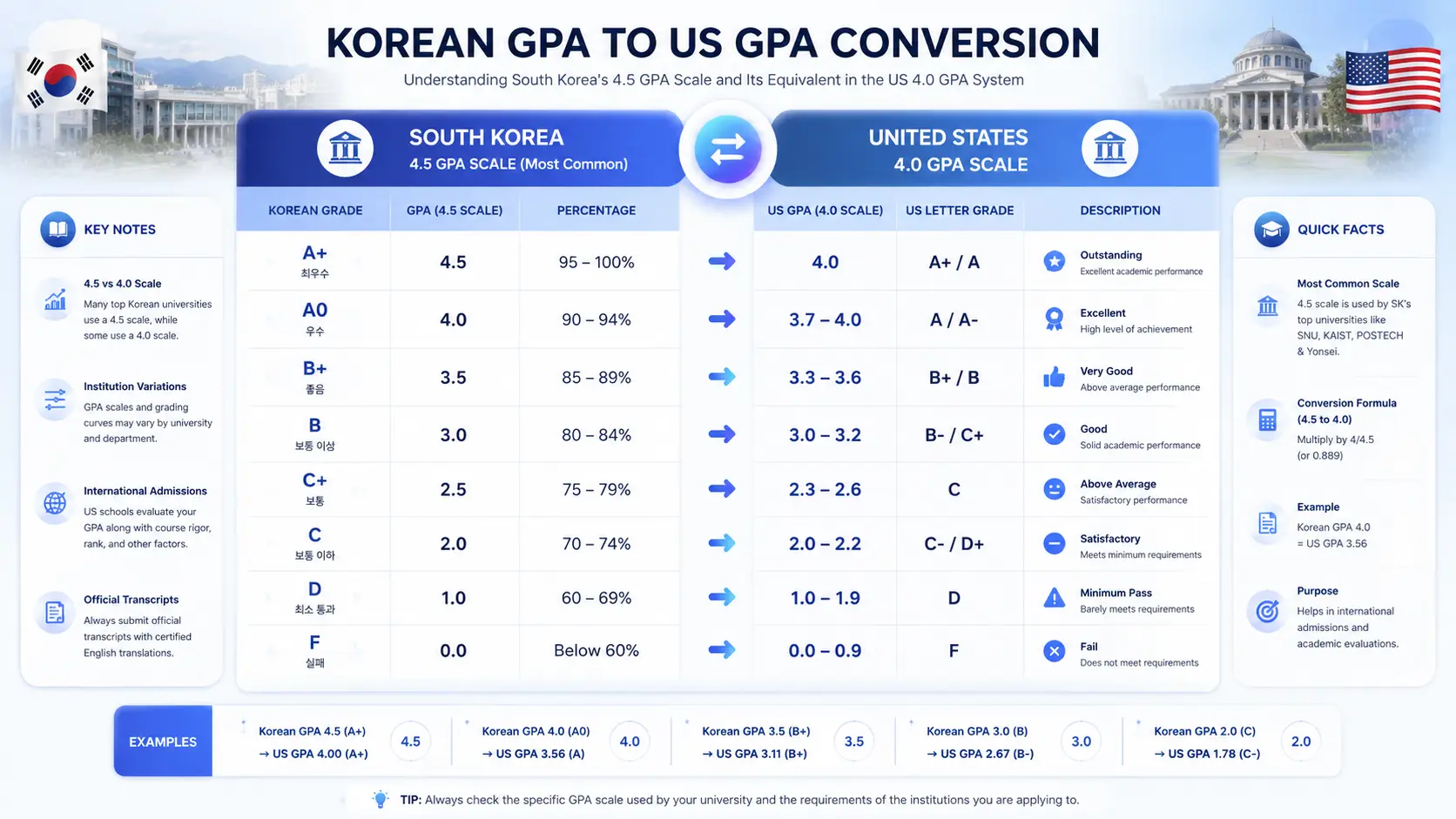
To convert a Korean 4.5 GPA to a US 4.0 GPA, multiply by 4/4.5 (≈ 0.889). Worked examples: 4.5 Korean ≈ 4.0 US, 4.0 Korean ≈ 3.56 US, 3.5 Korean ≈ 3.11 US, 3.0 Korean ≈ 2.67 US. For the 4.3 variant, multiply by 4/4.3 (≈ 0.93). For institutions already using the 4.0 scale, no conversion is needed.
Inside a Modern Korean University Classroom
Korean universities — particularly the SKY trio and KAIST/POSTECH — are known for rigorous academic culture, lecture-based instruction supplemented by problem sets and weekly assessments, and competitive grading distributions that deliberately cap A-range grades at roughly 30% of any given class.

Reading a Korean University Transcript
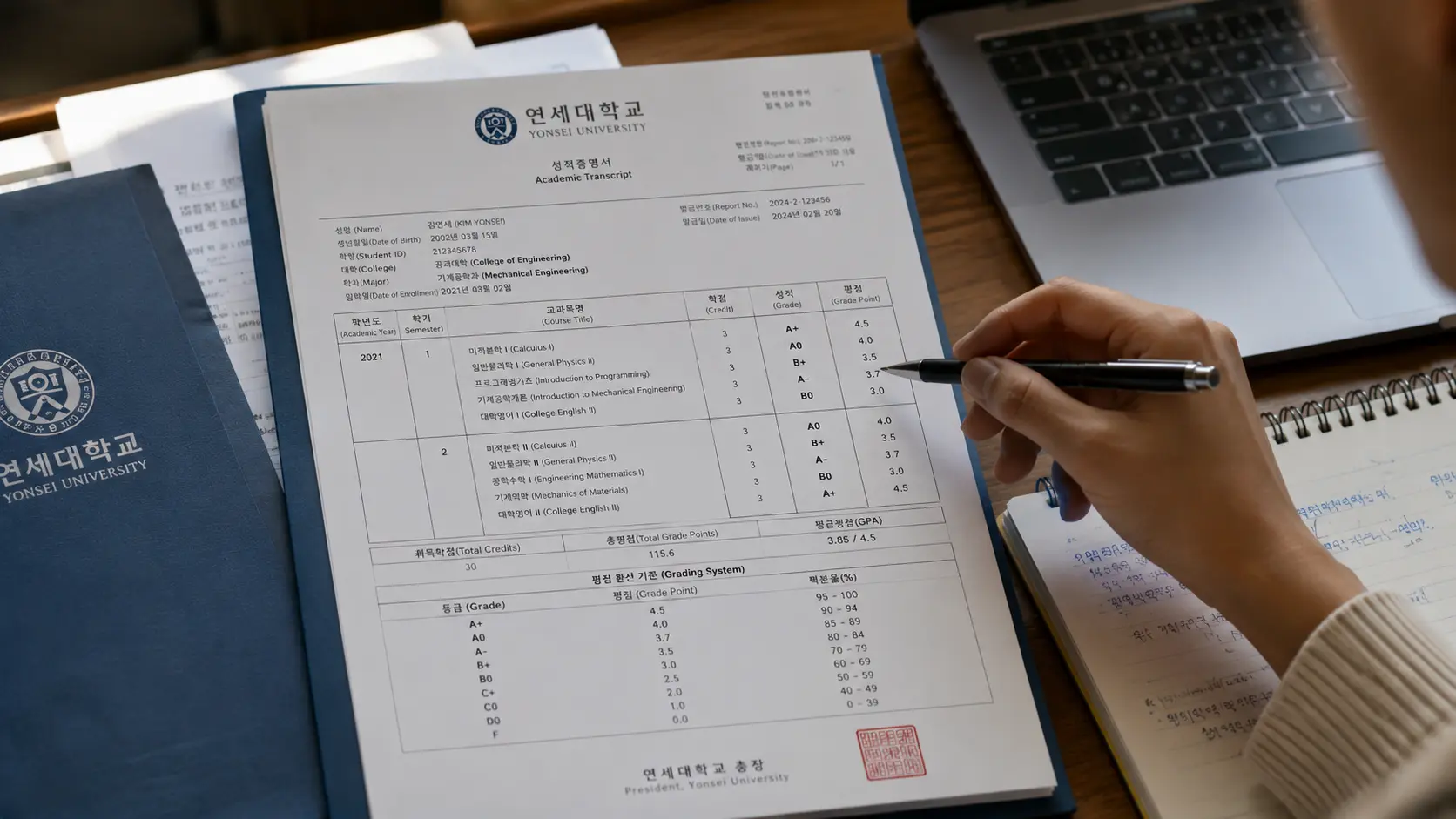
Korean university transcripts (성적증명서) list each course with its code, title, credit hours, letter grade, grade points (평점), and percentage marks. Your cumulative GPA (총 평점평균) appears at the bottom, often alongside a separate major GPA (전공 평점평균). Most Korean universities issue official English transcripts directly from the registrar.
Leading Universities in South Korea
- Seoul National University (SNU)
- Korea Advanced Institute of Science and Technology (KAIST)
- POSTECH (Pohang University of Science and Technology)
- Yonsei University
- Korea University
- Sungkyunkwan University (SKKU)
- Hanyang University
- UNIST
Counseling for International Students
SKY universities and KAIST/POSTECH all offer English-language graduate programmes with structured GPA assessment for international admissions, and most accept either the original Korean transcript or a WES-equivalent evaluation depending on the applicant's home country.

Frequently Asked Questions
Is a 4.0 GPA good in South Korea?
On the 4.5 scale used by most leading Korean universities, a 4.0 GPA is genuinely strong — equivalent to roughly an A0 average and approximately a 3.56 US GPA. At SKY universities and KAIST/POSTECH where grade distributions are deliberately strict, a 4.0 / 4.5 places you in the top 15-20% of your cohort.
How do I convert a Korean 4.5 GPA to a US 4.0 GPA?
Multiply your Korean GPA by 4/4.5 (≈ 0.889). For example: 4.5 → 4.0 US, 4.0 → 3.56 US, 3.5 → 3.11 US, 3.0 → 2.67 US. For the 4.3 variant, multiply by 4/4.3 (≈ 0.93).
What GPA do I need for KAIST or SNU graduate school?
The practical baseline is 3.5+ on the 4.5 scale (≈ 3.11 US GPA). Competitive STEM master's and PhD programmes expect 3.8 to 4.3 on the 4.5 scale, alongside strong research credentials.
What is the SKY in Korean universities?
SKY refers to Seoul National University (SNU), Korea University, and Yonsei University — the three most prestigious comprehensive universities in South Korea. KAIST and POSTECH are equivalent or stronger for engineering and STEM specifically.
Do US universities recognise Korean transcripts?
Yes — US universities widely recognise transcripts from accredited Korean universities. Credential evaluators including WES, ECE, and Spantran all process Korean transcripts as standard documents. Degrees from SKY, KAIST, and POSTECH carry particularly strong recognition.